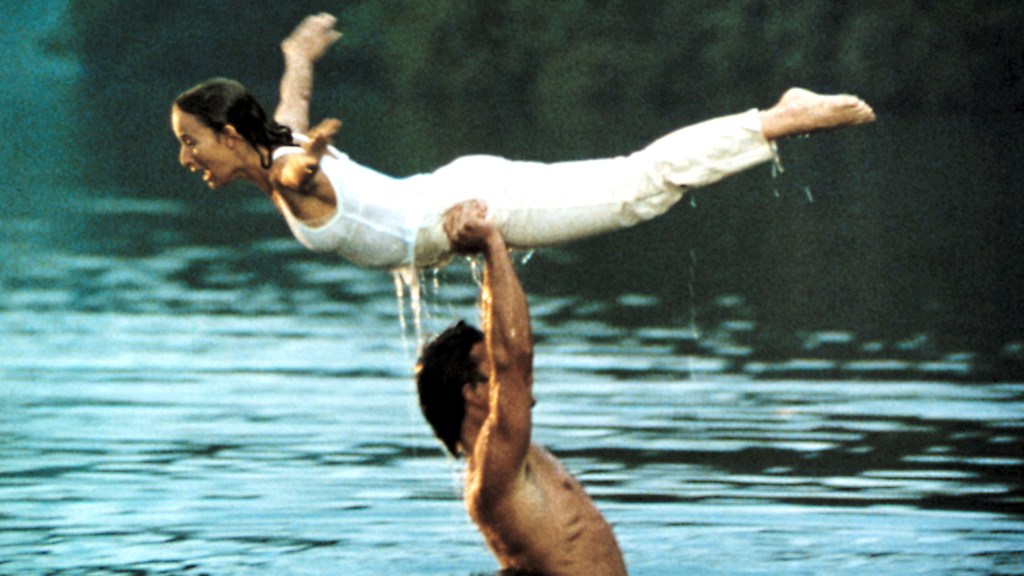
Somehow, I’d never seen this right through until tonight—but I’m glad I did, as it is a genuinely superb film. Sex sells—and there is nothing sexier to most men than women who can dance, dancing. But Dirty Dancing goes beyond that by conjuring many moments of emotional truth anyone can relate to—and it’s funny, which I would never have gotten from anything I’ve ever read or heard anyone say about it.
Some time ago, when I looked into it, I was astonished to learn that Jennifer Grey is the daughter of Joel Grey [riveting as the flamboyant Master of Ceremonies in Cabaret, 1972]. Her face, as she looks at Patrick Swayze, says everything that can be said about longing and frustration. Unfortunately, she didn’t much like her face, and, years later, did this to it:

Strangely, the one piece of casting that didn’t work for me was Swayze himself: it goes without saying his dancing is amazing, but he just cannot act convincingly when not doing the mambo.
Howard Hawks—director of To Have and Have Not (1944), The Big Sleep (1946) and Rio Bravo (1959), among many other iconic films—preferred to describe what he made as “entertainment,” rather than Art—and, of course, it was both—and in doing so recognized that entertainment is the art that reaches an audience. Which Dirty Dancing certainly did—and without compromising the Art.

 FATAL VISIONS