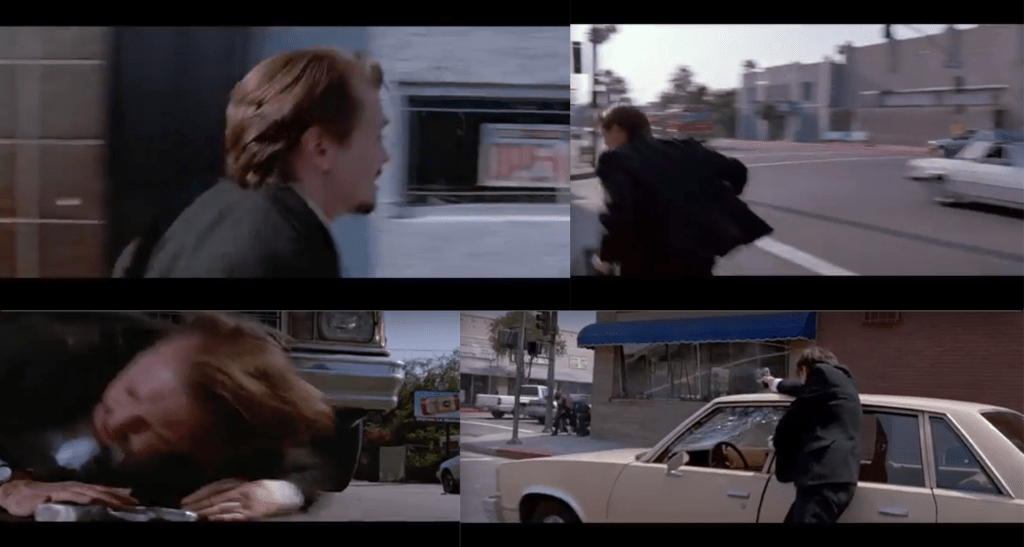
“Great artists don’t borrow—they steal.” Picasso said that. And he was right—but he wasn’t as great as Quentin Tarantino. At least, not as a filmmaker.
This re-release, which marks my first trip to a movie theater since the abomination that was The Irishman (2019), offers a way not to hate the whole business of trying to entertain oneself. In it, Tarantino channels Godard, Kubrick, Scorsese—Boorman, even—and everyone who came before who contributed to the development of film technique, all the way back to Eisenstein.
He takes these influences, and countless others, and, like all geniuses, makes something new, adding stuff no one thought of before: like Steven Wright’s hilariously languid disc jockey narrative inserts, movie-obsessed hardened criminals-within-the-movie talking about movies, and Harry Nilsson, singing offbeat, unclassifiable pop over the closing credits.
Yet, he is way more than a director’s director, or writer’s writer: he is a moviegoer’s director, and an actor’s director. He loves actors, and is the brilliantly original, if indulgent, casting director of his own movies. The ensemble he brings together here is electrifying. Chris Penn is genuinely terrifying; Lawrence Tierney and Ed Bunker look every bit the tough guys they actually are; Steve Buscemi’s uniquely gaunt, pallid appearance and highly strung demeanor are mesmerizing; and Harvey Keitel’s rough-hewn, intense presence serves as a focal point for the whole thing. But, when Keitel kicks a recumbent Buscemi, he does so like an Irish dancer warming up for a show; and Tim Roth’s performance is almost unvaryingly hysterical—implausibly so—with the exception of the imagined drug-dealer-confronted-by-cops-and-their-German Shepherd scene, in which he is singularly believable, and where Tarantino’s use of montage and slow motion creates moments of anticipatory fear, and relief, never bettered on film. Michael Madsen—whose looks recall Elvis Presley and presence John Garfield—though, steals the show as Mr Blond—and not only for his mesmerizing Stuck in the Middle with You cop-torture dance routine.
In Reservoir Dogs, there is greater urgency to the narrative than anything Tarantino has subsequently achieved; it is an object lesson in the principle of Less Is More, and an interesting contrast to the shapeless monstrosity that is Oliver Stone’s Natural Born Killers (1994), or Tony Scott’s slick, Top Gun-ish True Romance (1993)—both made from early Tarantino scripts. His lack of interest in women, except as proxy men, is a pervasive flaw—here, they scarcely appear, except to be shot dead—but, then again, nobody’s perfect.
Weirdly, for an actor, Tarantino is more charismatic in real life than on-screen, and an interview with him is usually at least as compelling as any random excerpt from one of his films. He can talk about movies, and his own process, as well as Hitchcock or Scorsese— and come acrosss as more likely to strike up a conversation with you in the queue for this movie—the one he directed.

 FATAL VISIONS
Reblogged this on FATAL VISIONS.
LikeLike